14. November, 2025
How Bear Markets Destroy Bad Signal Providers
Ever noticed how everyone’s a trading genius when Bitcoin’s going up?
When the market’s pumping, even terrible signal providers look like rock stars, but when the bear market hits—when prices are dropping for months on end—that’s when you see who’s actually legit and who was just lucky.
If you’re considering joining a signal service or already following one, it’s essential to understand what happens when markets turn south. Most signal providers that excel during bull markets completely fall apart when the bear market arrives.
In this article, I’m going to break down exactly how bear markets expose weak signal providers, what red flags to watch for, and how to protect your money when everyone else is losing theirs.
Why Bull Markets Make Everyone Look Smart
Let’s start with why this matters.
During a bull market, making money is easy. Prices are trending up. Every dip gets bought. “Buy the dip” actually works. Even if a signal provider has a mediocre strategy, they can still post wins because the overall trend is working in their favor.
Here’s what changes when markets turn bearish:
The “buy every dip” strategy stops working. What used to be a profitable dip now turns into a bigger drop. Then another drop. Then another. Suddenly, you’re down 30% on a trade that “should have bounced.”
Stop losses get hit constantly. Bear markets are choppy. Prices whipsaw up and down, triggering your stop loss before continuing the direction you thought it would go. It’s frustrating as hell.
Even good trades make less money. When the market’s falling, the bounces are smaller. You might still win, but instead of making 8-10%, you’re making 2-3%. Meanwhile, your losing trades can still drop 5-8% easily.
The math changes completely. And that’s when bad signal providers get exposed.
What Actually Happens to Win Rates in Bear Markets
Let me give you some real numbers so you understand what’s normal.
In bull markets: Good signal providers hit around 60-70% win rate. Some of the best can even hit 75%. Not bad, right?
In bear markets: That same provider will drop to 50-60% win rate. Sometimes even 45-50% if it’s a brutal downturn.
Not exactly. Here’s why their win rate drops:
- More fake-outs. Prices look like they’re bouncing, then they don’t. False breakouts everywhere.
- Volatility. Prices swing wildly, hitting stop losses that wouldn’t have been hit in calmer conditions.
- Emotion. When everyone’s scared, markets act unpredictable. Good technical setups fail more often.
So if a provider claims they maintain 70-80% win rate throughout a six-month bear market, that’s a giant red flag. Either they’re lying, or they’re counting their wins in a sketchy way.
The One Metric That Matters Most: Maximum Drawdown
Here’s a term you need to understand: maximum drawdown.
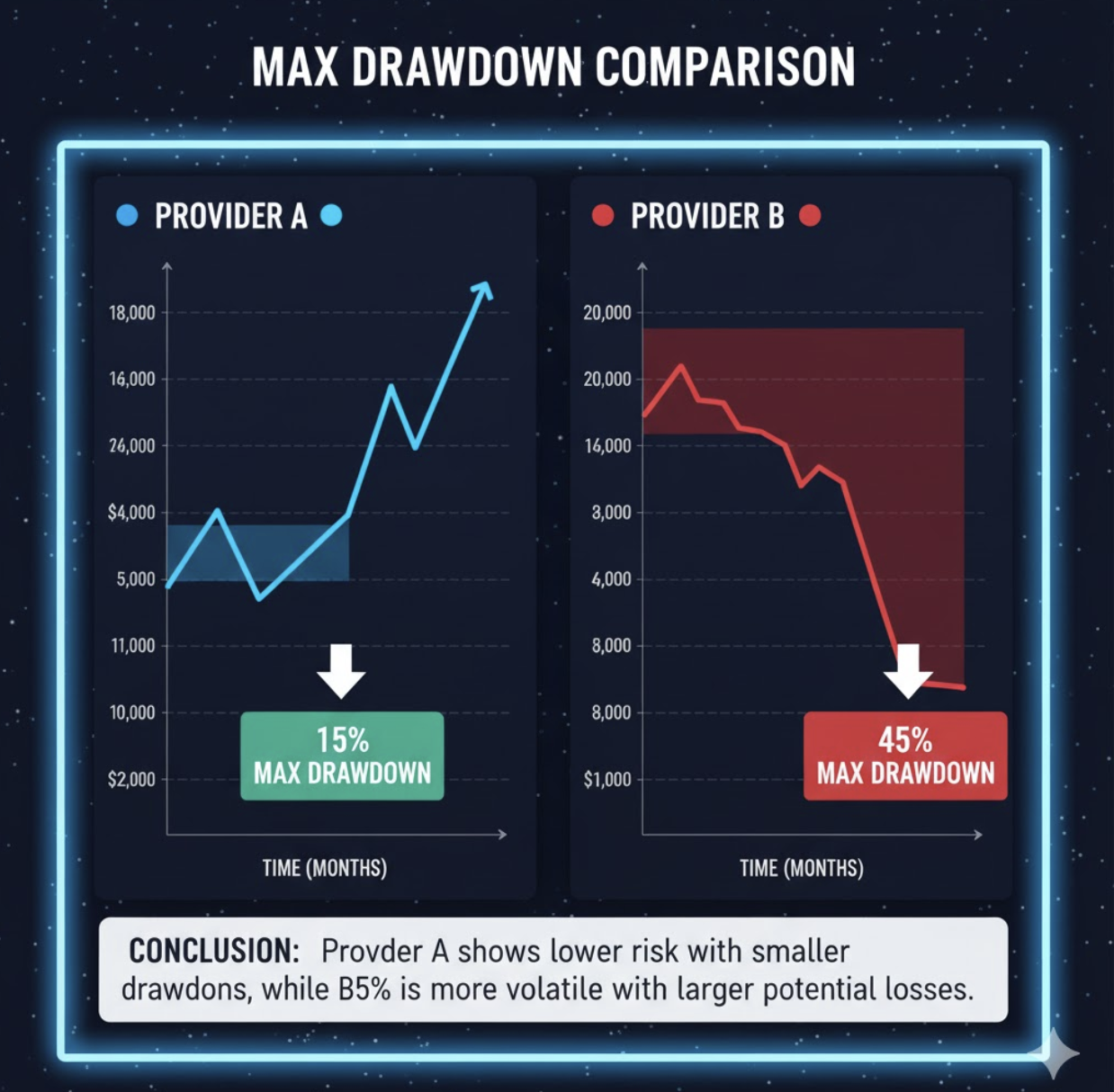
Maximum drawdown is the biggest drop from peak to bottom that your account experiences. Think of it like the worst losing streak measured in dollars.
Example: Let’s say your account grows to $10,000 (your peak). Then you hit a rough patch and drop to $7,500. That’s a 25% drawdown. If that’s the worst it ever got, your maximum drawdown is 25%.
Why does this matter so much in bear markets?
Because this number tells you how much pain you’ll have to endure before things recover. And in bear markets, this number gets scary fast for bad providers.
Here’s what I’ve seen from analyzing tons of providers:
- Great providers: 10-15% maximum drawdown even in bear markets
- Good providers: 15-25% maximum drawdown
- Risky providers: 25-35% maximum drawdown
- Run-away-immediately providers: 35%+ maximum drawdown
Common Mistake: Beginners focus on win rate and ignore drawdown. But drawdown is way more important. A 40% drawdown will destroy your account—and your confidence—even if you eventually recover.
The Four Ways Signal Providers Fail in Bear Markets
After watching this play out over and over, I’ve noticed providers fail in predictable ways. Here are the four most common:
1. They Can’t Stop “Buying the Dip”
Some providers built their entire strategy around bull markets. They only know how to look for buying opportunities.
So when the bear market hits, what do they do? They keep trying to buy dips. Over and over. Even as the price keeps dropping.
Real example: During summer 2022, I watched a provider send 43 “buy ETH” signals as Ethereum dropped from $2,800 down to $1,100. Forty-three times they called it a bottom. Their philosophy was “always be invested.”
Anyone following those signals got wrecked. Down 60%+ while people who just held cash were fine.
The problem? They had no strategy for downtrends. No short signals. No “sit in cash” recommendation. Just endless dip buying that turned into dip catching all the way down.
2. They Start Revenge Trading
Here’s another thing that happens: After a provider hits a losing streak, they panic.
Instead of taking a step back, they double down. They start sending way more signals, trying to make back the losses quickly. The quality of the signals tanks because they’re taking setups they normally wouldn’t take.
What it looks like:
- Signal frequency suddenly doubles or triples
- Signals with lower confidence (“This is a 50/50 shot but let’s try it”)
- Bigger position sizes recommended (trying to recover losses faster)
- Emotional language (“We NEED this win!”)
This is called revenge trading, and it’s a death spiral. The more they lose, the more desperately they trade, the worse the results get.
3. They Start Lying About Results
This is the really shady stuff. When results get bad, some providers straight-up manipulate their track record.
How they do it:
- Deleting losing signals from their Telegram channel
- Editing messages after the fact to change entry or exit prices
- Claiming certain trades “don’t count” because of [insert BS reason]
- Only highlighting the wins in their updates while ignoring losses
Red flags to watch for:
- Deleted message history in signal channels (major red flag)
- Results they claim don’t match what members actually experienced
- Refusing to use third-party tracking tools that can’t be edited
- Win rates that mysteriously improve during bear markets
If you catch any of this, leave immediately. This is fraud, plain and simple.
4. They Ghost the Community
Some providers just give up but keep charging you anyway. The signals slow to a trickle. One per week. Then one every two weeks. The analysis stops. Questions go unanswered. The provider basically abandons ship while still collecting monthly fees.
Warning signs:
- Signals become rare or stop completely
- No explanation for the silence
- Copy-paste analysis with no real insight
- Admins stop responding to questions
- Days pass between any activity
How Good Providers Handle Bear Markets Differently
Okay, enough doom and gloom. Let’s talk about what GOOD providers do when markets turn bearish. These are the providers worth following because they actually adapt instead of going down with the ship.
They Send Fewer Signals
First thing you’ll notice: they slow down. Instead of 10 signals a week, maybe now it’s 4-6. Why? Because in bear markets, you need to be way pickier. Not every setup is worth taking. The good providers understand this and focus on quality over quantity.
They’re essentially saying: “The conditions suck right now, so we’re only taking the absolute best setups.” This is actually a really good sign. It means they have discipline.
They Tell You to Hold More Cash
Good providers will straight-up tell you to keep 30-50% and manage your portfolio in cash during rough markets. Why? Because sitting in cash during a crash is actually a winning strategy. You’re preserving capital for when conditions improve. Not everything needs to be invested all the time. Bad providers feel pressure to constantly give signals because that’s what people are paying for. Good providers care more about your account not blowing up.
They Actually Use Short Positions
Here’s something that separates the pros from the amateurs: willingness to short.
Shorting means profiting when prices go down. You’re betting against the market.
Providers who only know how to go long (buying with hopes of price going up) are one-trick ponies. When the market’s falling, they have no tools. Good providers will mix in short signals during downtrends. They’re making money while the market falls instead of just bleeding money on failed bounces. If your provider never sends short signals, they’re limited. Period.
They’re Transparent About the Struggle
Here’s maybe the biggest difference: good providers are honest when things suck.
They’ll send updates like:
- “Market conditions are brutal right now. We’re reducing signal frequency until we see clearer setups.”
- “That’s three losses in a row. We’re going to take a step back and reassess.”
- “Our priority right now is capital preservation, not trying to catch every bounce.”
This kind of honesty builds trust. They’re not pretending everything’s fine when it isn’t. Bad providers never admit struggle. They keep hyping up signals like normal, even as losses pile up.
Questions You Should Ask Any Signal Provider
If you’re considering joining a signal service, or if you’re in one now and want to evaluate if you should stay, ask these questions:
About their bear market performance:
- What was your maximum drawdown during the 2022 bear market?
- How did your win rate change from bull to bear market?
- Can I see third-party verified results covering at least one full bear market?
About their strategy:
- How does your approach change in bear markets?
- What percentage of your signals are shorts vs longs?
- When do you recommend sitting in cash instead of taking new trades?
About risk management:
- What’s your recommended risk per trade in bear markets?
- How do you adjust position sizing when volatility spikes?
- Do you ever move stop losses after entering a trade? (The answer should be NO or only in specific protective scenarios)
About transparency:
- Do you use any third-party tracking? (Like Myfxbook or public bots)
- Can I see your complete history including losses?
- What’s your refund policy if results don’t match what you promised?
Good providers will answer these confidently. Bad providers will dodge, get defensive, or give vague answers.
Pro Tip: If a provider gets angry or defensive when you ask about their bear market performance, that tells you everything you need to know. Leave.
Quick Recap
Here’s what we covered:
- Bull markets make bad providers look good—bear markets expose the truth
- Win rates naturally drop in bear markets—even good providers drop from 65% to 50-55%
- Maximum drawdown is the key metric—good providers stay under 25% even in crashes
- Providers fail in four predictable ways—can’t adapt, revenge trade, manipulate results, or ghost
- Good providers slow down, use cash, short the market, and communicate honestly
- Always verify bear market performance before subscribing—if they can’t prove it, assume they can’t handle it
Your Next Steps
Today: If you’re currently in a signal service, go check their message history. Look for how they performed during May-October 2022 (a brutal bear market). Did they maintain discipline or did they fall apart?
This Week: If you’re considering joining a signal service, ask them the questions I listed above. See how they respond. Their answers (or non-answers) will tell you everything.
Ongoing: Remember that no signal provider is a magic solution. Even the best ones have rough patches. Your own risk management—position sizing, stop losses, emotional control—is always your first line of defense.
Disclaimer: This article is for educational purposes only and should not be considered financial advice. Cryptocurrency trading involves substantial risk of loss. Always do your own research and consider consulting with a financial advisor before making investment decisions.